THIS IS AN IN-PERSON ONLY EVENT.
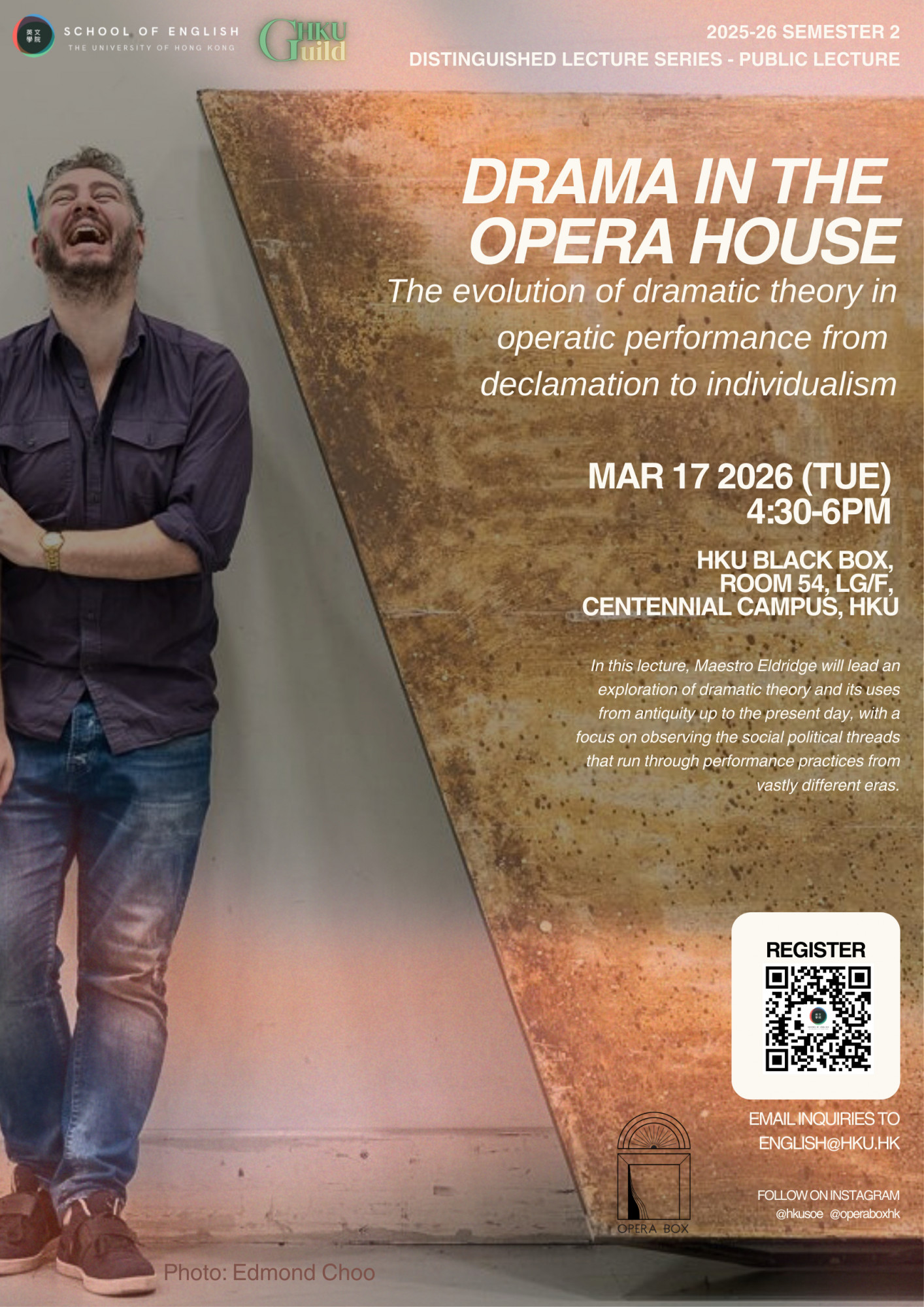
Mr. Greg Eldridge – Public Lecture & Workshops
Venue: HKU Black Box, Room 54, LG/F, Centennial Campus, HKU (Location map)
Registration is required. Very limited seats. No walk-in allowed. Successful registrants will be selected after the deadline of 12:00 noon on March 11, 2026 (Wednesday).
||
Public Lecture
|
Event
|
Date & Time
|
Title
|
Abstract
|
Registration
|
|
Public Lecture |
March 17, 2026 (Tuesday) |
Public Lecture Drama in the Opera House: The Evolution of Dramatic Theory in Operatic Performance from Declamation to Individualism |
In this lecture, Maestro Eldridge will lead an exploration of dramatic theory and its uses from antiquity up to the present day, with a focus on observing the socio-political threads that run through performance practices from vastly different eras. |
|
||
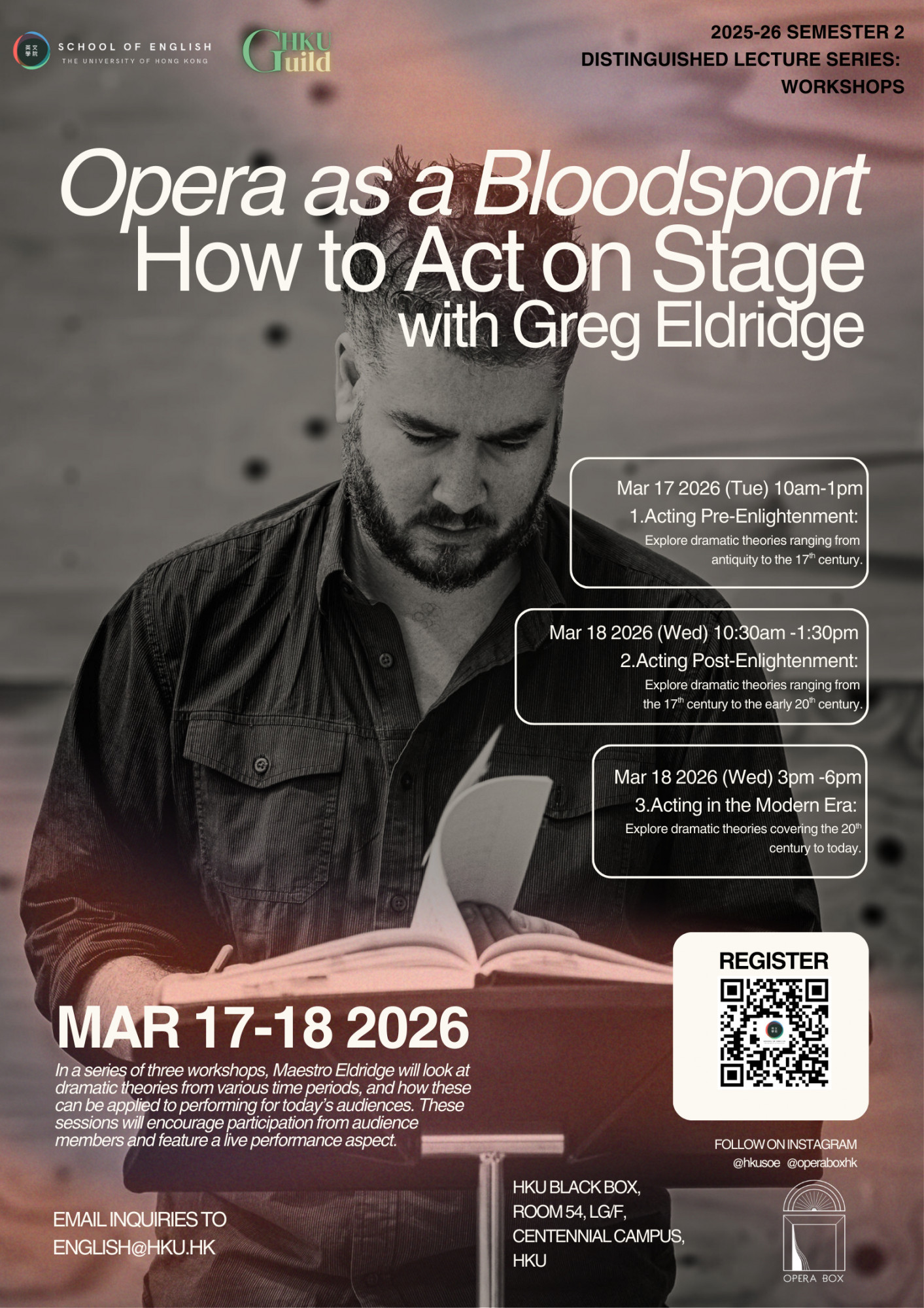
Workshops
In a series of three workshops, Maestro Eldridge will look at dramatic theories from various time periods, and how these can be applied to performing for today’s audiences. These sessions will encourage participation from audience members and feature a live performance aspect.
|
Event
|
Date & Time
|
Title
|
Abstract
|
Registration
|
|
Workshop |
March 17, 2026 (Tuesday) |
Workshop 1 Opera as a Bloodsport–How to Act on Stage: Acting Pre-Enlightenment |
In this workshop, Maestro Eldridge will look at dramatic theories ranging from antiquity to the 17th century. |
|
|
Workshop |
March 18, 2026 (Wednesday) |
Workshop 2 Opera as a Bloodsport–How to Act on Stage: Acting Post-Enlightenment |
In this workshop, Maestro Eldridge will look at dramatic theories ranging from the 17th century to the early 20th century. |
|
|
Workshop |
March 18, 2026 (Wednesday) |
Workshop 3 Opera as a Bloodsport–How to Act on Stage: Acting in the Modern Era |
In this workshop, Maestro Eldridge will look at dramatic theories covering 20th century and the most recent contemporary dramatic works. |
|
||
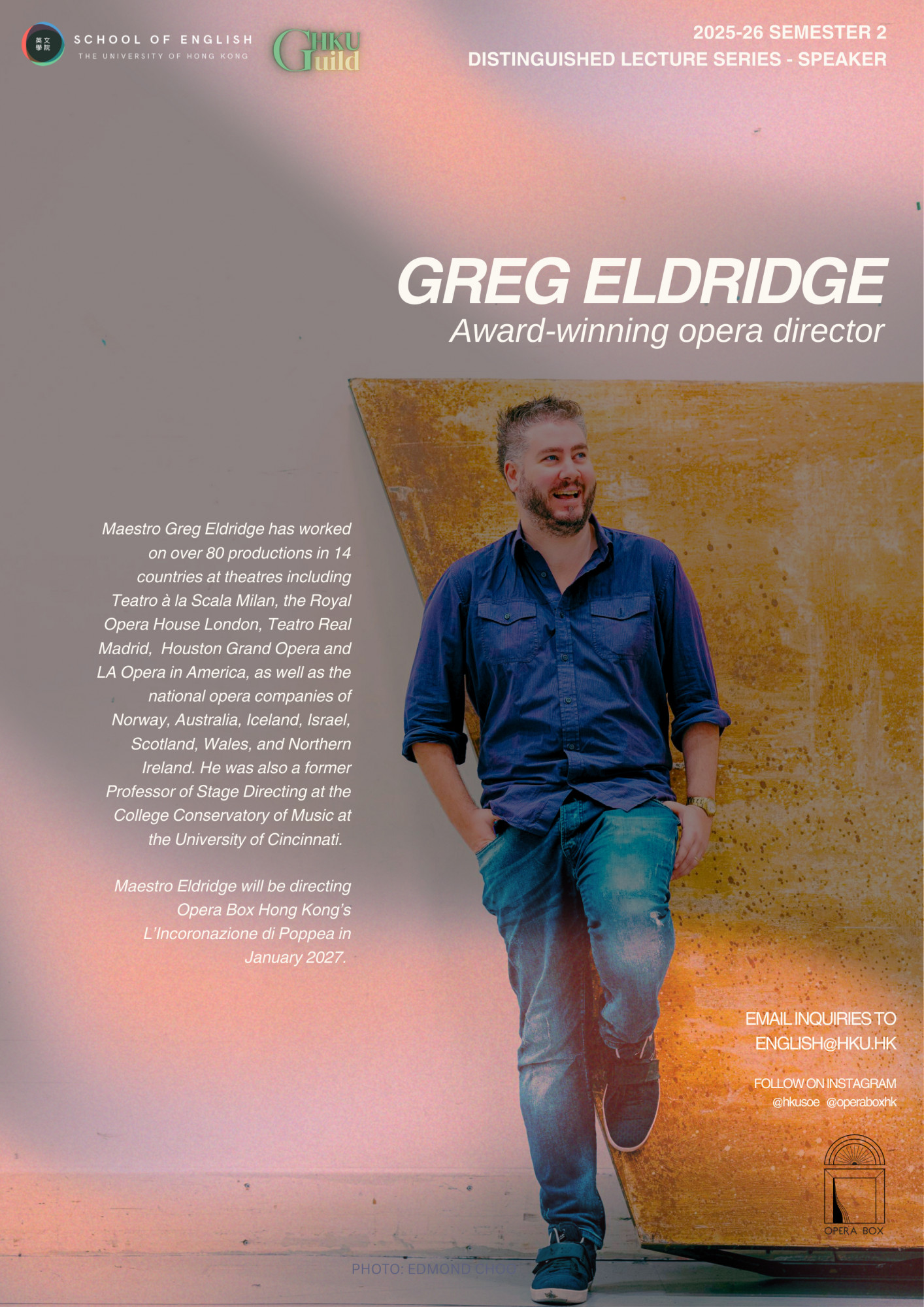
Biography
Maestro Greg Eldridge has worked on over 80 productions in 14 countries at theatres including Teatro à la Scala Milan, the Royal Opera House London, Teatro Real Madrid, Houston Grand Opera and LA Opera in America, as well as the national opera companies of Norway, Australia, Iceland, Israel, Scotland, Wales, and Northern Ireland. He was also a former Professor of Stage Directing at the College of Conservatory of Music at the University of Cincinnati.
THIS IS AN IN-PERSON ONLY EVENT.
Professor David Huddart – Public Lecture
Date: April 30, 2026 (Thursday)
Time: 4:00pm – 5:30pm
Venue: HKU Black Box, Room 54, LG/F, Centennial Campus, HKU (Location map)
Registration is required. Seats are available on a first-come, first-served basis.
- For HKU members (HKU Portal login is required): https://hkuems1.hku.hk/hkuems/ec_hdetail.aspx?ueid=106496
- For non-HKU members: https://hkuems1.hku.hk/hkuems/ec_hdetail.aspx?guest=Y&ueid=106496
||
Abstract
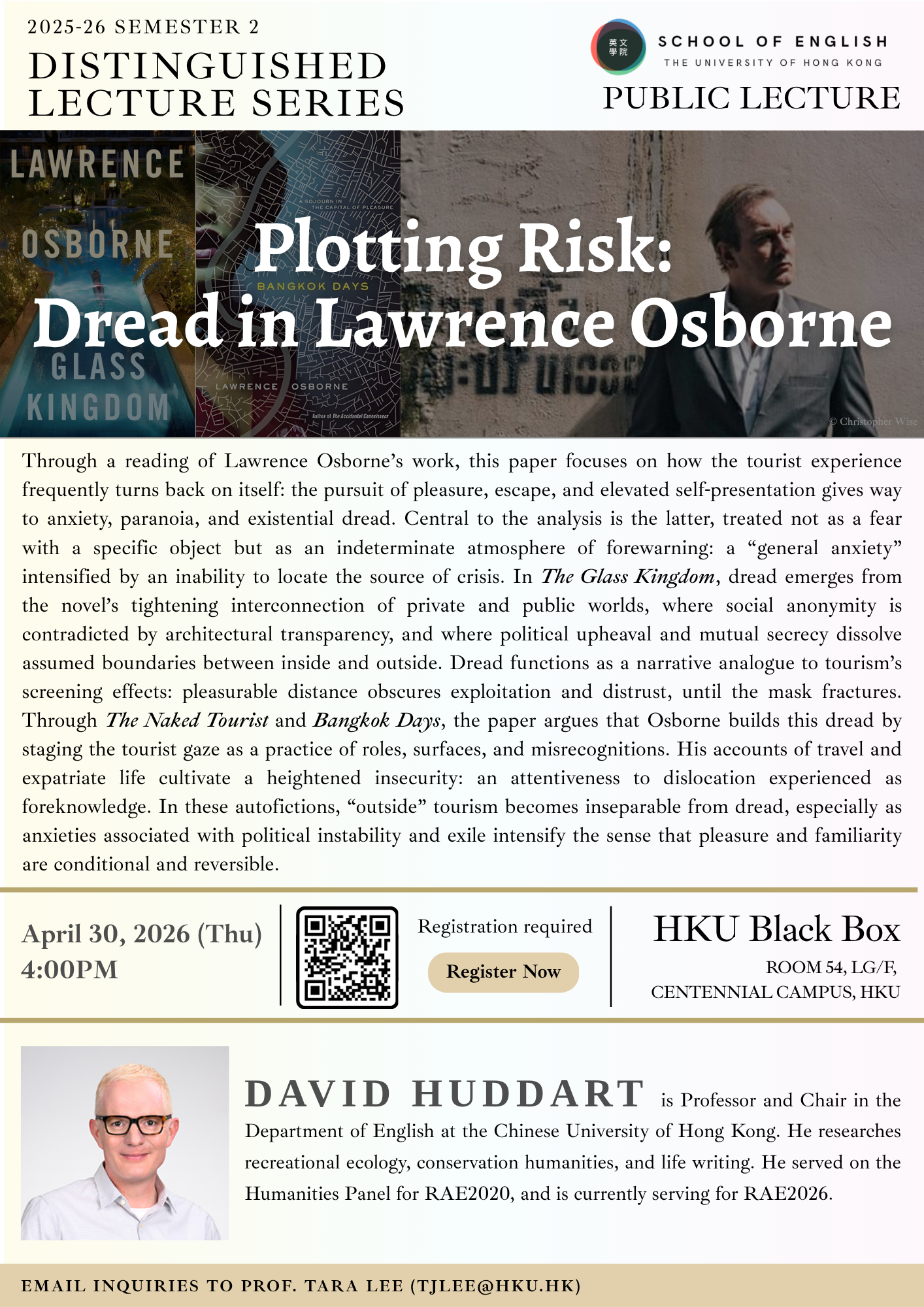
Through a reading of Lawrence Osborne’s work, this paper focuses on how the tourist experience frequently turns back on itself: the pursuit of pleasure, escape, and elevated self-presentation gives way to anxiety, paranoia, and existential dread. Central to the analysis is the latter, treated not as a fear with a specific object but as an indeterminate atmosphere of forewarning: a “general anxiety” intensified by an inability to locate the source of crisis. In The Glass Kingdom, dread emerges from the novel’s tightening interconnection of private and public worlds, where social anonymity is contradicted by architectural transparency, and where political upheaval and mutual secrecy dissolve assumed boundaries between inside and outside. Dread functions as a narrative analogue to tourism’s screening effects: pleasurable distance obscures exploitation and distrust, until the mask fractures. Through The Naked Tourist and Bangkok Days, the paper argues that Osborne builds this dread by staging the tourist gaze as a practice of roles, surfaces, and misrecognitions. His accounts of travel and expatriate life cultivate a heightened insecurity: an attentiveness to dislocation experienced as foreknowledge. In these autofictions, “outside” tourism becomes inseparable from dread, especially as anxieties associated with political instability and exile intensify the sense that pleasure and familiarity are conditional and reversible.
||
Biography
David Huddart is Professor and Chair in the Department of English at the Chinese University of Hong Kong. He researches recreational ecology, conservation humanities, and life writing. He served on the Humanities Panel for RAE2020, and is currently serving for RAE2026.
||
Additional Content
THIS IS AN IN-PERSON ONLY EVENT.
Professor Carmen Lee – Public Lecture
Date: April 24, 2026 (Friday)
Time: 4:00pm – 5:30pm
Venue: HKU Black Box, Room 54, LG/F, Centennial Campus, HKU (Location map)
Registration is required. Seats are available on a first-come, first-served basis.
- For HKU members (HKU Portal login is required): https://hkuems1.hku.hk/hkuems/ec_hdetail.aspx?ueid=106211
- For non-HKU members: https://hkuems1.hku.hk/hkuems/ec_hdetail.aspx?guest=Y&ueid=106211
||
Abstract
Public discourse about linguistic correctness and norms has been well documented in sociolinguistics. In the post-digital era, however, metalinguistic commentary circulates rapidly across platforms and media contexts, often marked by intense affect of disdain and moral indignation directed not only at individual speakers but also at the social groups they are assumed to represent. This talk draws on digitally-mediated interaction and interview data from Hong Kong to examine “grassroots aggressive prescriptivism”, the hostile, emotionally charged ways in which ordinary people discuss, police, and condemn the linguistic practices of others. Tracing how such discourse is recontextualized from offline linguistic landscape and media reports to online comment threads and back into everyday life, this talk demonstrates that the affective dimensions of such metalinguistic discourse are not merely expressive of linguistic prejudice. Mediated through platform affordances and polymedia circulation, aggressive prescriptivism emerges as a site of engagement through which collective identities in post-digital Hong Kong are discursively constructed, contested, and renegotiated.
||
Biography
Carmen Lee is Professor in the Department of English at the Chinese University of Hong Kong, and co‑Editor‑in‑Chief of the journal Discourse, Context & Media. Her research focuses on digital discourse, digital multilingualism, and online verbal aggression. Her recent publications include the second edition of Language Online (Routledge, 2026, with D. Barton) and Doxxing Discourse (CUP, 2026). Her current projects examine the interplay between online and offline linguistic landscapes.
||
Additional Content
THIS IS AN IN-PERSON ONLY EVENT.
Public Lecture
Date: April 2, 2026 (Thursday)
Time: 4:00 pm – 5:30 pm
Venue: HKU Black Box, Room 54, LG/F, Centennial Campus, HKU (Location map) (MTR: Exit C1)
Registration is required. Seats are available on a first-come, first-served basis.
|
Title
|
Abstract
|
Registration
|
|
The End of Literature? AI and the Future of Writing |
What will AI do to literature? Nobody doubts that Large Language Models (LLMs) can produce text. Indeed, there are fears of a text-apocalypse, as bots speak to bots, humans automate their own writing, and the processed word proliferates. But what happens to literature, to literary writing, and even to literary theory, in all this? Literature might be simulated perhaps, but can it be generated anew? Is there even such as thing as AI literature? If so, how might we taxonomise it, understand it as distinctive, or study it? Perhaps we should consider instead what might be termed a post-literature – if so what might this look like? This lecture takes up some of these questions through a re-consideration of creativity, understood not as a single moment, or a single work, but as process generated across what is here termed a new passage of forms. |
|
||
Reading Group
Date: April 1, 2026 (Wednesday)
Time: 4:00 pm – 5:30 pm
Venue: XR Space, Arts Tech Lab, Room 4.35, 4/F, Run Run Shaw Tower, Centennial Campus, HKU (MTR: Exit C1)
Registration is required. Seats are available on a first-come, first-served basis.
|
Title
|
Abstract
|
Registration
|
|
Authors, Deadbots, Science Fiction |
I research technical media and cultural change – often in relation to specific forms (literature, visual culture, media arts), but also in relation to theory and method. In this reading group I’ve included some work that looks at different aspects of this. The first reading considers the future of literature in an age of GenAI. The second reading explores the uncanny and the digital afterlife. The third is brief and considers the relationship between fictional and ‘real’ futures. I hope we can use them as a jumping off point to explore some of the themes that interest me, and that might also be areas you are working on. I’ve included an article on scholarly editing if you have time for some background reading. Reading List – reading materials will be sent upon successful registration Key reading:
Optional reading:
|
|
||
Biography
Caroline Bassett is Professor of Digital Humanities, Director of Cambridge Digital Humanities, a member of the Faculty of English and a Fellow of Corpus Christi College at the University of Cambridge. She researches medium technologies and cultural change with a focus on critical theory, gender and technology, and critical methods. Key book length publications include Anti-Computing (MUP, 2022), a cultural history of automation fever, Furious (Pluto, 2020), a co-authored work exploring gender, ambition and future technologies, and The Arc and the Machine (MUP, 2014), which explored narrative and computation. She is widely published in academic and public fora. Current projects focus on AI and writing, critical medium theory, artificial creativity, future collapse, and on the politics and aesthetics of refusal.
||
Additional Content
THIS IS AN IN-PERSON ONLY EVENT.
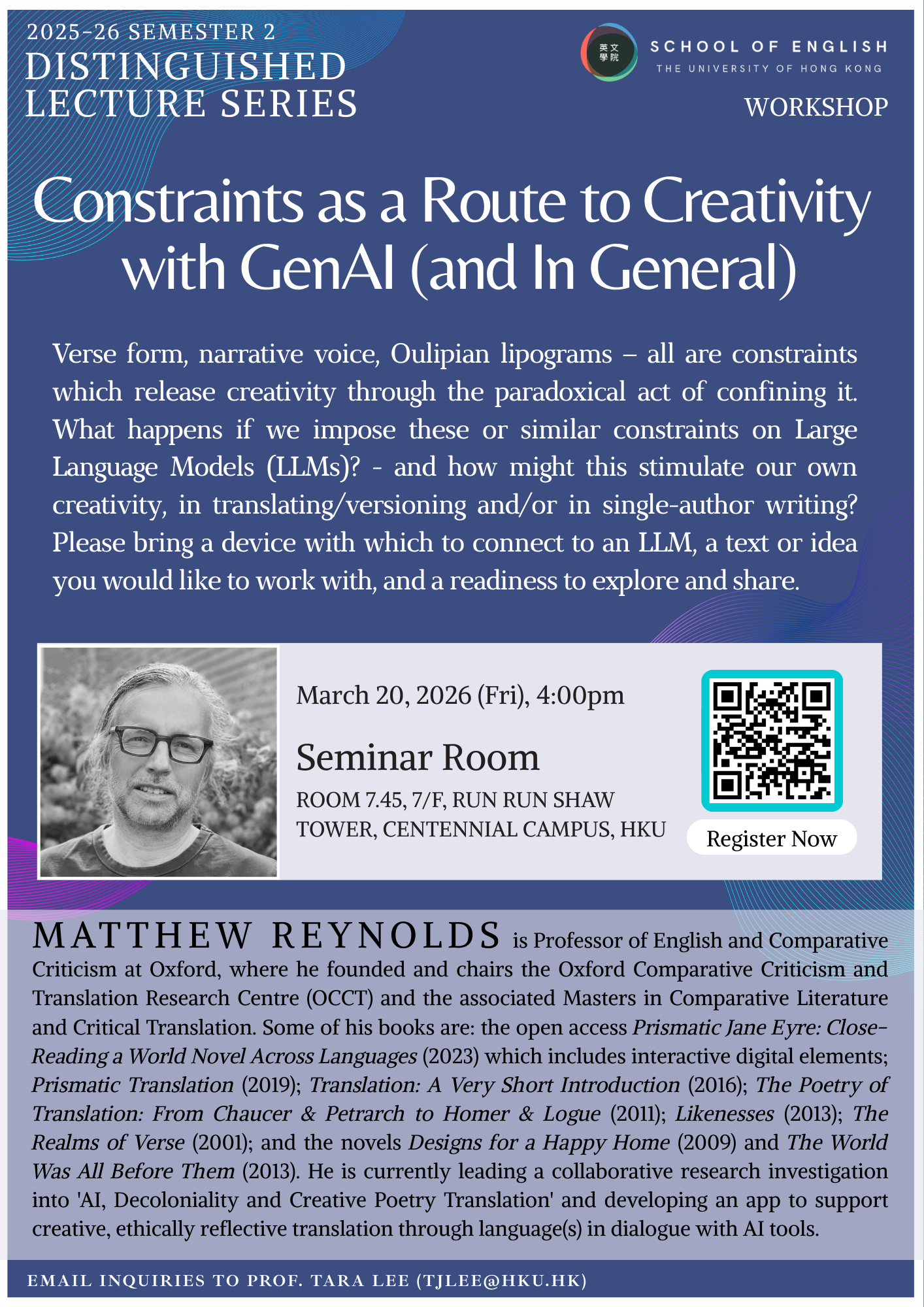
Professor Matthew Reynolds – Workshop
Date: Mar 20, 2026 (Friday)
Time: 4:00pm – 5:30pm
Venue: Seminar Room, Room 7.45, 7/F, Run Run Shaw Tower, Centennial Campus, HKU
Registration is required. Seats are available on a first-come, first-served basis.
- For HKU members (HKU Portal login is required): https://hkuems1.hku.hk/hkuems/ec_hdetail.aspx?ueid=105510
- For non-HKU members: https://hkuems1.hku.hk/hkuems/ec_hdetail.aspx?guest=Y&ueid=105510
||
Abstract
Verse form, narrative voice, Oulipian lipograms – all are constraints which release creativity through the paradoxical act of confining it. What happens if we impose these or similar constraints on Large Language Models (LLMs)? – and how might this stimulate our own creativity, in translating/versioning and/or in single-author writing? Please bring a device with which to connect to an LLM, a text or idea you would like to work with, and a readiness to explore and share.
||
Biography
Matthew Reynolds is Professor of English and Comparative Criticism at Oxford, where he founded and chairs the Oxford Comparative Criticism and Translation Research Centre (OCCT) and the associated Masters in Comparative Literature and Critical Translation. Some of his books are: the open access Prismatic Jane Eyre: Close-Reading a World Novel Across Languages (2023) which includes interactive digital elements; Prismatic Translation (2019); Translation: A Very Short Introduction (2016); The Poetry of Translation: From Chaucer & Petrarch to Homer & Logue (2011); Likenesses (2013); The Realms of Verse (2001); and the novels Designs for a Happy Home (2009) and The World Was All Before Them (2013). He is currently leading a collaborative research investigation into 'AI, Decoloniality and Creative Poetry Translation' and developing an app to support creative, ethically reflective translation through language(s) in dialogue with AI tools.
||
Additional Content
THIS IS AN IN-PERSON ONLY EVENT.
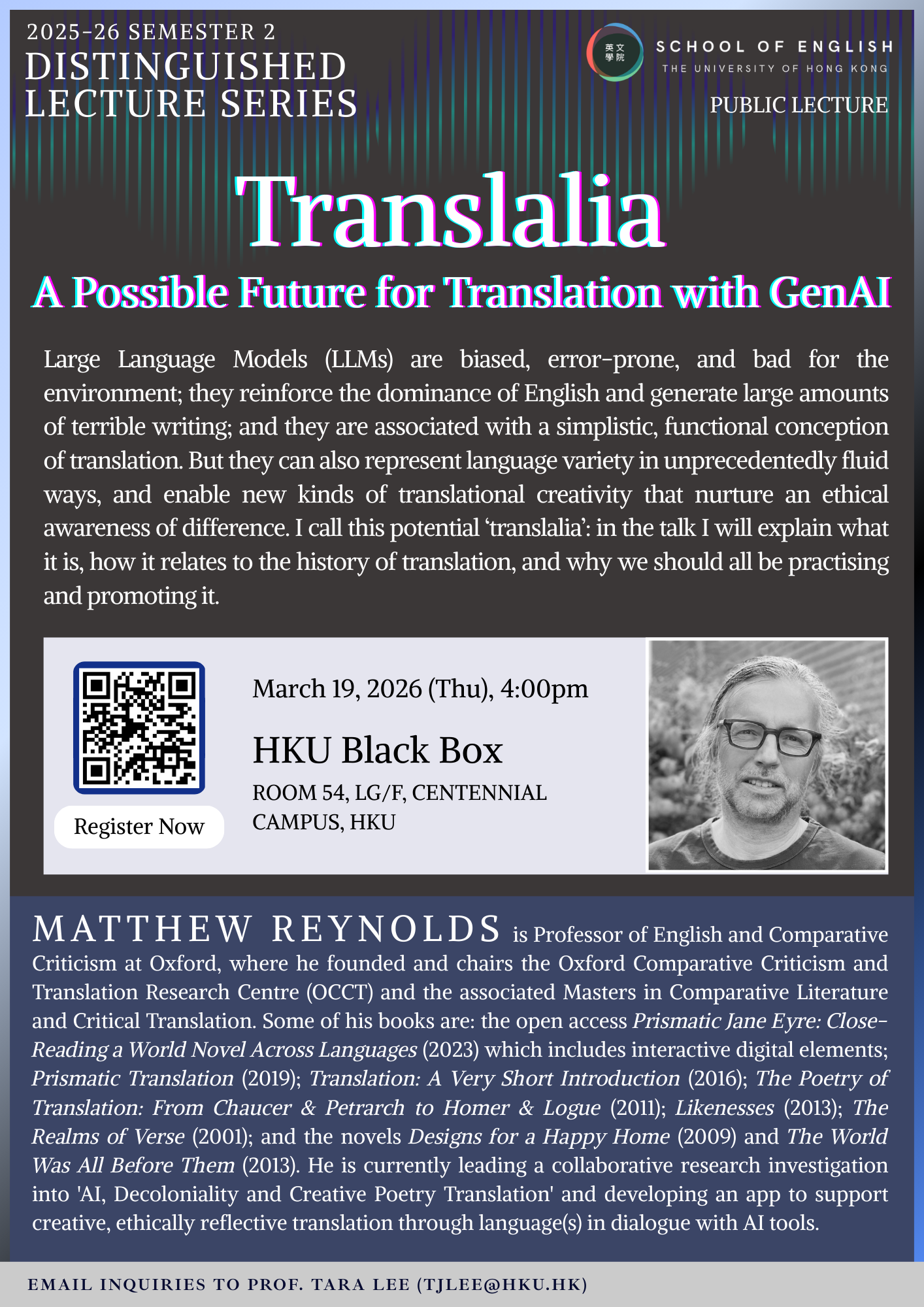
Professor Matthew Reynolds – Public Lecture
Date: Mar 19, 2026 (Thursday)
Time: 4:00pm – 5:30pm
Venue: HKU Black Box, Room 54, LG/F, Centennial Campus, HKU (Location map)
Registration is required. Seats are available on a first-come, first-served basis.
- For HKU members (HKU Portal login is required): https://hkuems1.hku.hk/hkuems/ec_hdetail.aspx?ueid=105508
- For non-HKU members: https://hkuems1.hku.hk/hkuems/ec_hdetail.aspx?guest=Y&ueid=105508
||
Abstract
Large Language Models (LLMs) are biased, error-prone, and bad for the environment; they reinforce the dominance of English and generate large amounts of terrible writing; and they are associated with a simplistic, functional conception of translation. But they can also represent language variety in unprecedentedly fluid ways, and enable new kinds of translational creativity that nurture an ethical awareness of difference. I call this potential ‘translalia’: in the talk I will explain what it is, how it relates to the history of translation, and why we should all be practising and promoting it.
||
Biography
Matthew Reynolds is Professor of English and Comparative Criticism at Oxford, where he founded and chairs the Oxford Comparative Criticism and Translation Research Centre (OCCT) and the associated Masters in Comparative Literature and Critical Translation. Some of his books are: the open access Prismatic Jane Eyre: Close-Reading a World Novel Across Languages (2023) which includes interactive digital elements; Prismatic Translation (2019); Translation: A Very Short Introduction (2016); The Poetry of Translation: From Chaucer & Petrarch to Homer & Logue (2011); Likenesses (2013); The Realms of Verse (2001); and the novels Designs for a Happy Home (2009) and The World Was All Before Them (2013). He is currently leading a collaborative research investigation into 'AI, Decoloniality and Creative Poetry Translation' and developing an app to support creative, ethically reflective translation through language(s) in dialogue with AI tools.
||
Additional Content
THIS IS AN IN-PERSON ONLY EVENT.
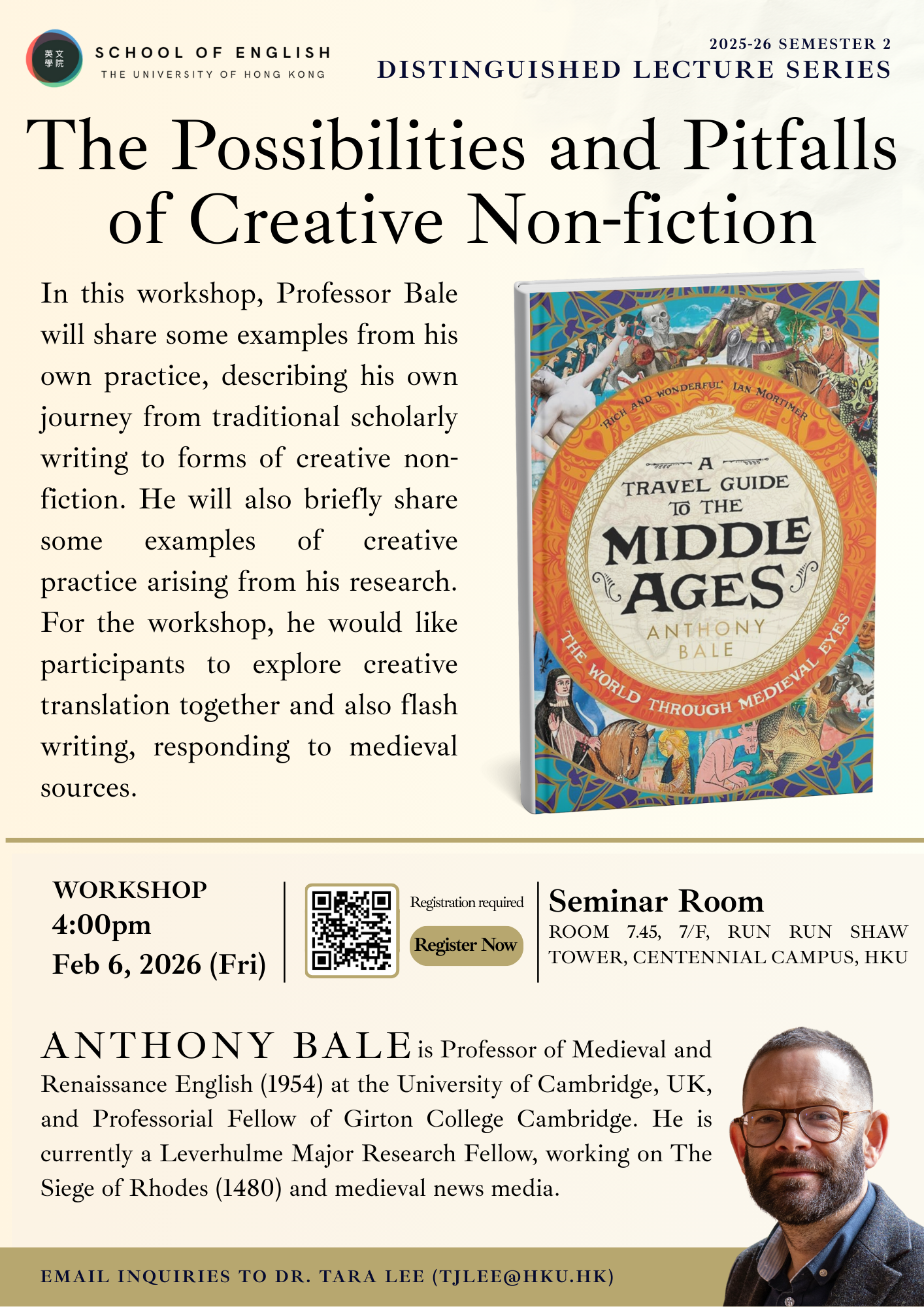
Professor Anthony Bale – Workshop
Date: February 6, 2026 (Friday)
Time: 4:00pm – 5:30pm
Venue: Seminar Room, Room 7.45, 7/F, Run Run Shaw Tower, Centennial Campus, HKU
Registration is required. Seats are available on a first-come, first-served basis.
- For HKU members (HKU Portal login is required): https://hkuems1.hku.hk/hkuems/ec_hdetail.aspx?ueid=104908
- For non-HKU members: https://hkuems1.hku.hk/hkuems/ec_hdetail.aspx?guest=Y&ueid=104908
||
Abstract
In this workshop I will share some examples from my own practice, describing my own journey from traditional scholarly writing to forms of creative non-fiction. I will also briefly share some examples of creative practice arising from my research. For the workshop I would like us to explore creative translation together and also flash writing, responding to medieval sources.
||
Biography
Anthony Bale is Professor of Medieval and Renaissance English (1954) at the University of Cambridge, UK, and Professorial Fellow of Girton College Cambridge. He is currently a Leverhulme Major Research Fellow, working on The Siege of Rhodes (1480) and medieval news media.
||
Additional Content
THIS IS AN IN-PERSON ONLY EVENT.
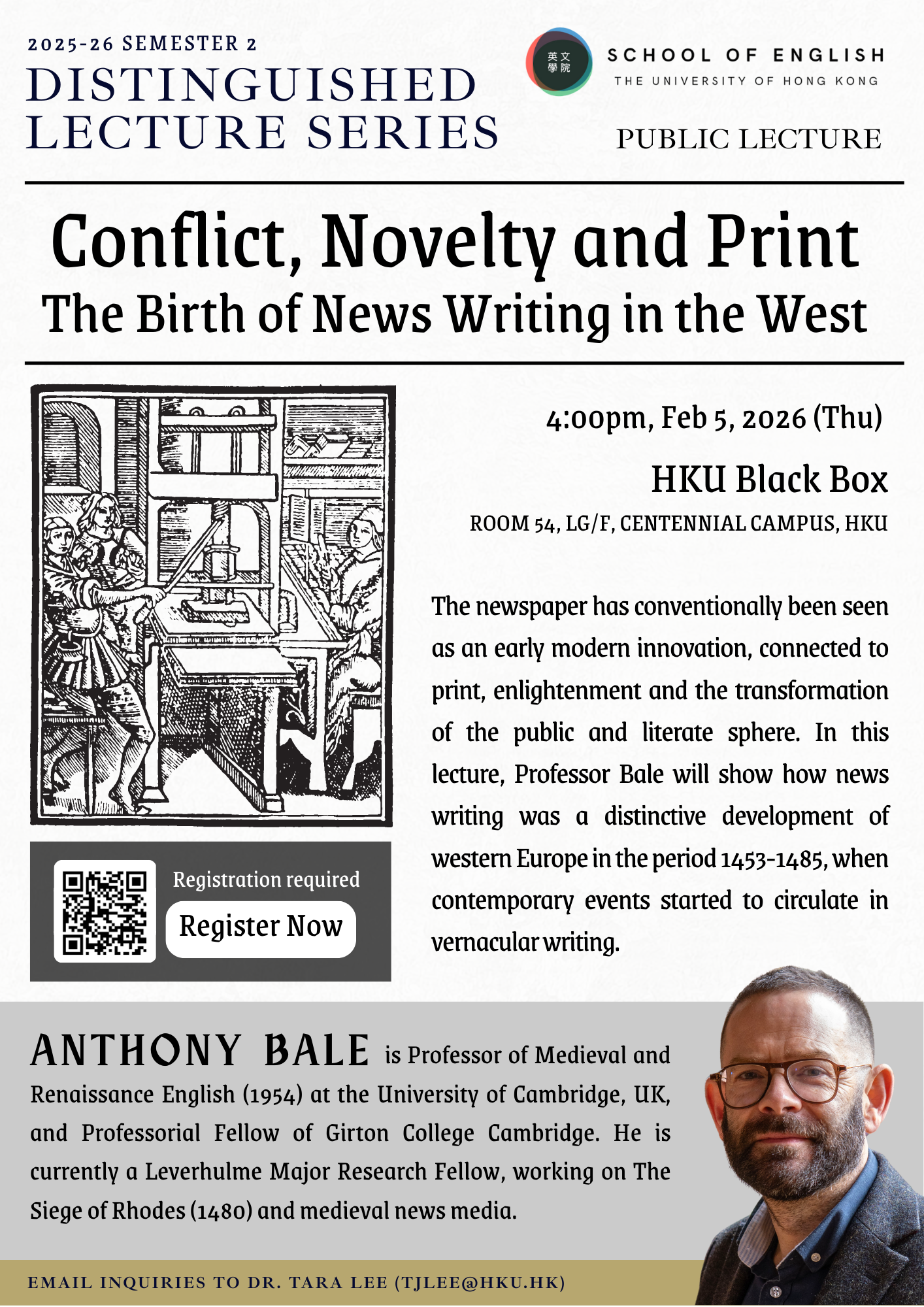
Professor Anthony Bale – Public Lecture
Date: February 5, 2026 (Thursday)
Time: 4:00pm – 5:30pm
Venue: HKU Black Box, Room 54, LG/F, Centennial Campus, HKU (Location map)
Registration is required. Seats are available on a first-come, first-served basis.
- For HKU members (HKU Portal login is required): https://hkuems1.hku.hk/hkuems/ec_hdetail.aspx?ueid=104907
- For non-HKU members: https://hkuems1.hku.hk/hkuems/ec_hdetail.aspx?guest=Y&ueid=104907
||
Abstract
The newspaper has conventionally been seen as an early modern innovation, connected to print, enlightenment and the transformation of the public and literate sphere. In this lecture I will show how news writing was a distinctive development of western Europe in the period 1453-1485, when contemporary events started to circulate in vernacular writing.
||
Biography
Anthony Bale is Professor of Medieval and Renaissance English (1954) at the University of Cambridge, UK, and Professorial Fellow of Girton College Cambridge. He is currently a Leverhulme Major Research Fellow, working on The Siege of Rhodes (1480) and medieval news media.
||
Additional Content
THIS IS AN IN-PERSON ONLY EVENT.
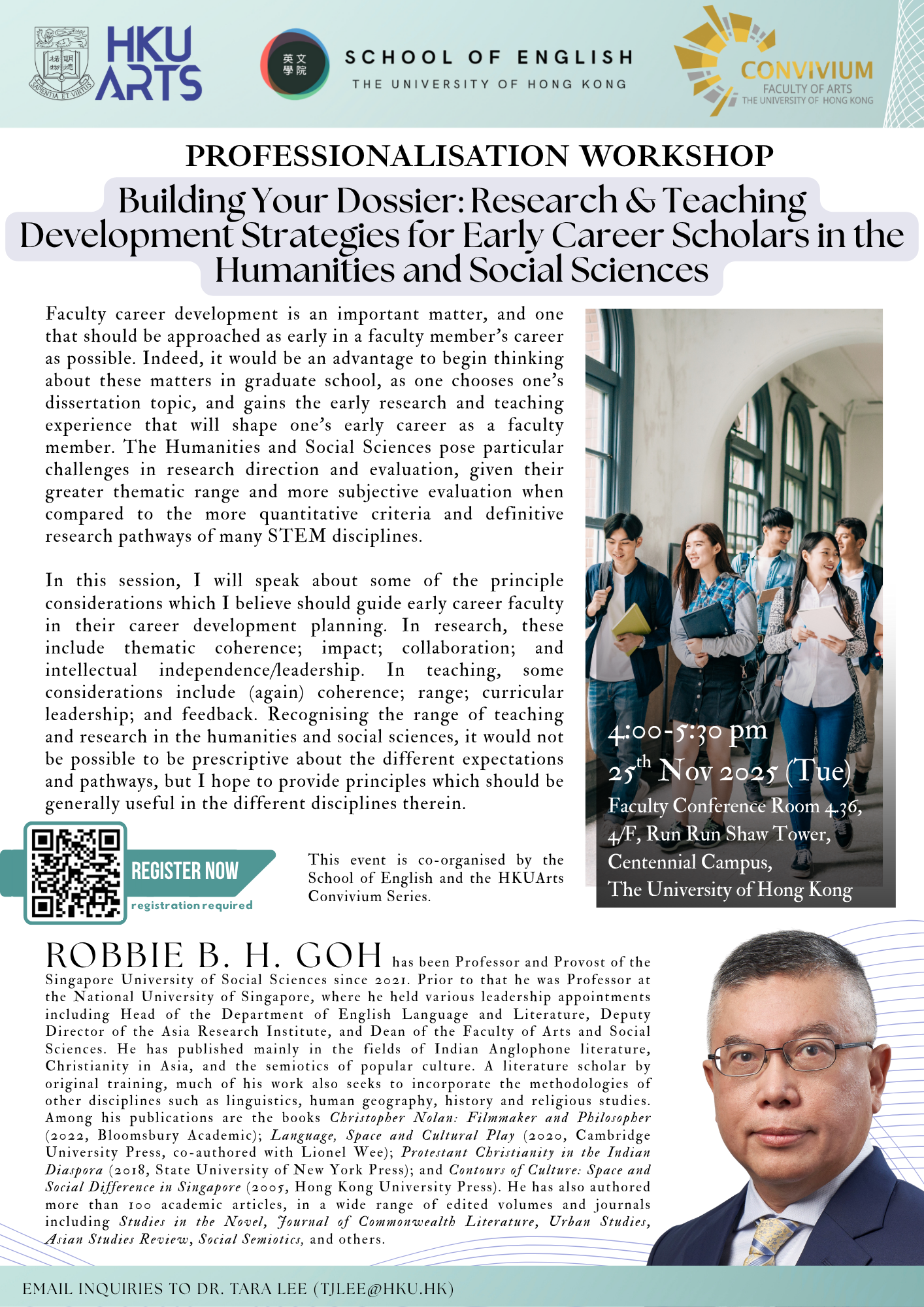
Professor Robbie B. H. Goh – Professionalisation Workshop
Date: 25th November, 2025 (Tuesday)
Time: 4:00pm – 5:30pm
Venue: Faculty Conference Room 436, 4/F, Run Run Shaw Tower, Centennial Campus, The University of Hong Kong
Registration is required. Seats are available on a first-come, first-served basis.
- For HKU members (HKU Portal login is required): https://hkuems1.hku.hk/hkuems/ec_hdetail.aspx?ueid=103740
- For non-HKU members: https://hkuems1.hku.hk/hkuems/ec_hdetail.aspx?guest=Y&ueid=103740
||
Abstract
Faculty career development is an important matter, and one that should be approached as early in a faculty member’s career as possible. Indeed, it would be an advantage to begin thinking about these matters in graduate school, as one chooses one’s dissertation topic, and gains the early research and teaching experience that will shape one’s early career as a faculty member. The Humanities and Social Sciences pose particular challenges in research direction and evaluation, given their greater thematic range and more subjective evaluation when compared to the more quantitative criteria and definitive research pathways of many STEM disciplines.
In this session, I will speak about some of the principle considerations which I believe should guide early career faculty in their career development planning. In research, these include thematic coherence; impact; collaboration; and intellectual independence/leadership. In teaching, some considerations include (again) coherence; range; curricular leadership; and feedback. Recognising the range of teaching and research in the humanities and social sciences, it would not be possible to be prescriptive about the different expectations and pathways, but I hope to provide principles which should be generally useful in the different disciplines therein.
||
Biography
Robbie B. H. Goh has been Professor and Provost of the Singapore University of Social Sciences since 2021. Prior to that he was Professor at the National University of Singapore, where he held various leadership appointments including Head of the Department of English Language and Literature, Deputy Director of the Asia Research Institute, and Dean of the Faculty of Arts and Social Sciences. He has published mainly in the fields of Indian Anglophone literature, Christianity in Asia, and the semiotics of popular culture. A literature scholar by original training, much of his work also seeks to incorporate the methodologies of other disciplines such as linguistics, human geography, history and religious studies. Among his publications are the books Christopher Nolan: Filmmaker and Philosopher (2022, Bloomsbury Academic); Language, Space and Cultural Play (2020, Cambridge University Press, co-authored with Lionel Wee); Protestant Christianity in the Indian Diaspora (2018, State University of New York Press); and Contours of Culture: Space and Social Difference in Singapore (2005, Hong Kong University Press). He has also authored more than 100 academic articles, in a wide range of edited volumes and journals including Studies in the Novel, Journal of Commonwealth Literature, Urban Studies, Asian Studies Review, Social Semiotics, and others.
THIS IS AN IN-PERSON ONLY EVENT.
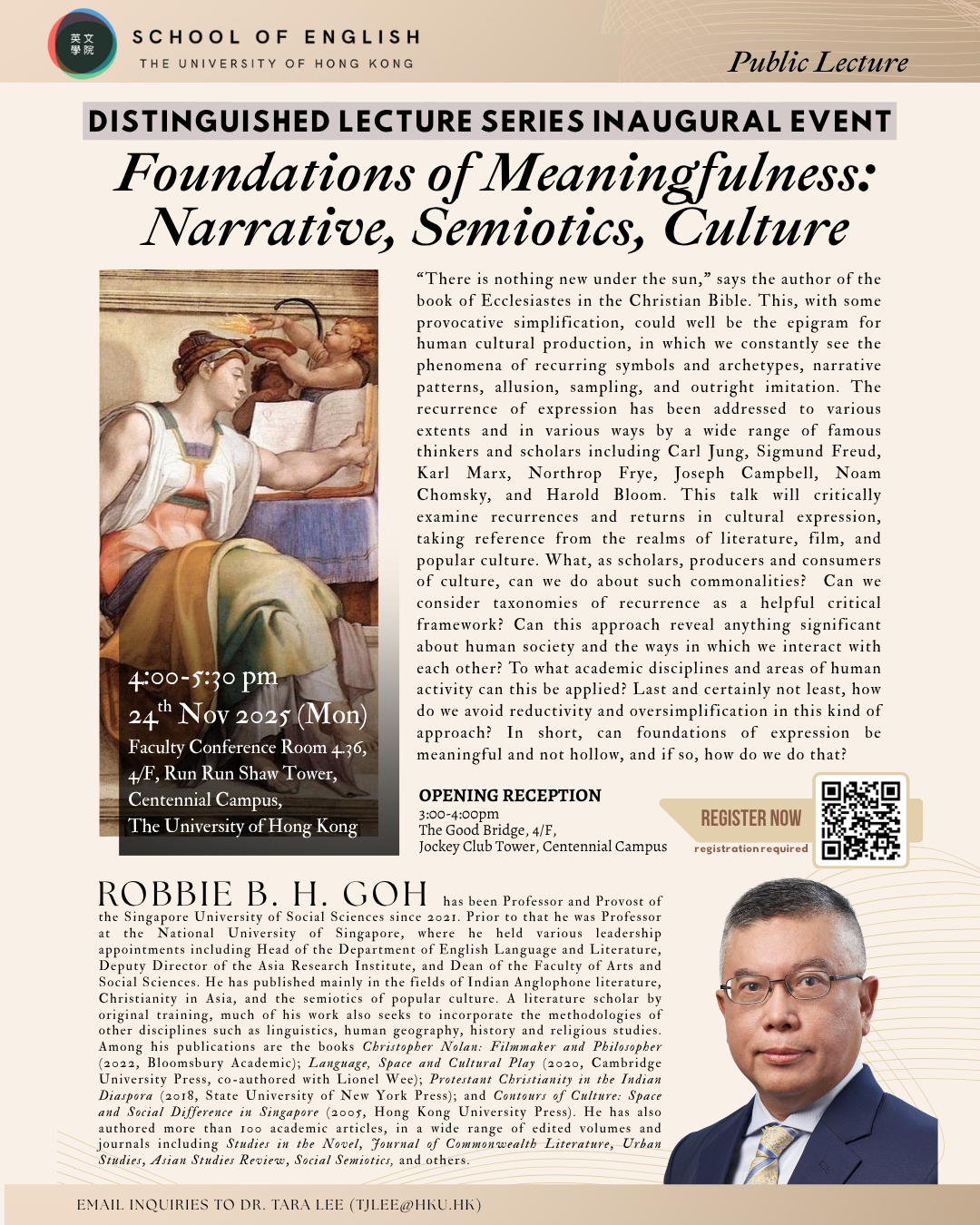
Professor Robbie B. H. Goh – Distinguished Lecture Series
Date: 24th November, 2025 (Monday)
Time: 3:00pm – 4:00pm
Venue: The Good Bridge, 4/F, Jockey Club Tower, Centennial Campus, The University of Hong Kong
Time: 4:00pm – 5:30pm
Venue: Faculty Conference Room 436, 4/F, Run Run Shaw Tower, Centennial Campus, The University of Hong Kong
Registration is required. Seats are available on a first-come, first-served basis.
- For HKU members (HKU Portal login is required): https://hkuems1.hku.hk/hkuems/ec_hdetail.aspx?ueid=103739
- For non-HKU members: https://hkuems1.hku.hk/hkuems/ec_hdetail.aspx?guest=Y&ueid=103739
||
Abstract
“There is nothing new under the sun,” says the author of the book of Ecclesiastes in the Christian Bible. This, with some provocative simplification, could well be the epigram for human cultural production, in which we constantly see the phenomena of recurring symbols and archetypes, narrative patterns, allusion, sampling, and outright imitation. The recurrence of expression has been addressed to various extents and in various ways by a wide range of famous thinkers and scholars including Carl Jung, Sigmund Freud, Karl Marx, Northrop Frye, Joseph Campbell, Noam Chomsky, and Harold Bloom. This talk will critically examine recurrences and returns in cultural expression, taking reference from the realms of literature, film, and popular culture. What, as scholars, producers and consumers of culture, can we do about such commonalities? Can we consider taxonomies of recurrence as a helpful critical framework? Can this approach reveal anything significant about human society and the ways in which we interact with each other? To what academic disciplines and areas of human activity can this be applied? Last and certainly not least, how do we avoid reductivity and oversimplification in this kind of approach? In short, can foundations of expression be meaningful and not hollow, and if so, how do we do that?
||
Biography
Robbie B. H. Goh has been Professor and Provost of the Singapore University of Social Sciences since 2021. Prior to that he was Professor at the National University of Singapore, where he held various leadership appointments including Head of the Department of English Language and Literature, Deputy Director of the Asia Research Institute, and Dean of the Faculty of Arts and Social Sciences. He has published mainly in the fields of Indian Anglophone literature, Christianity in Asia, and the semiotics of popular culture. A literature scholar by original training, much of his work also seeks to incorporate the methodologies of other disciplines such as linguistics, human geography, history and religious studies. Among his publications are the books Christopher Nolan: Filmmaker and Philosopher (2022, Bloomsbury Academic); Language, Space and Cultural Play (2020, Cambridge University Press, co-authored with Lionel Wee); Protestant Christianity in the Indian Diaspora (2018, State University of New York Press); and Contours of Culture: Space and Social Difference in Singapore (2005, Hong Kong University Press). He has also authored more than 100 academic articles, in a wide range of edited volumes and journals including Studies in the Novel, Journal of Commonwealth Literature, Urban Studies, Asian Studies Review, Social Semiotics, and others.